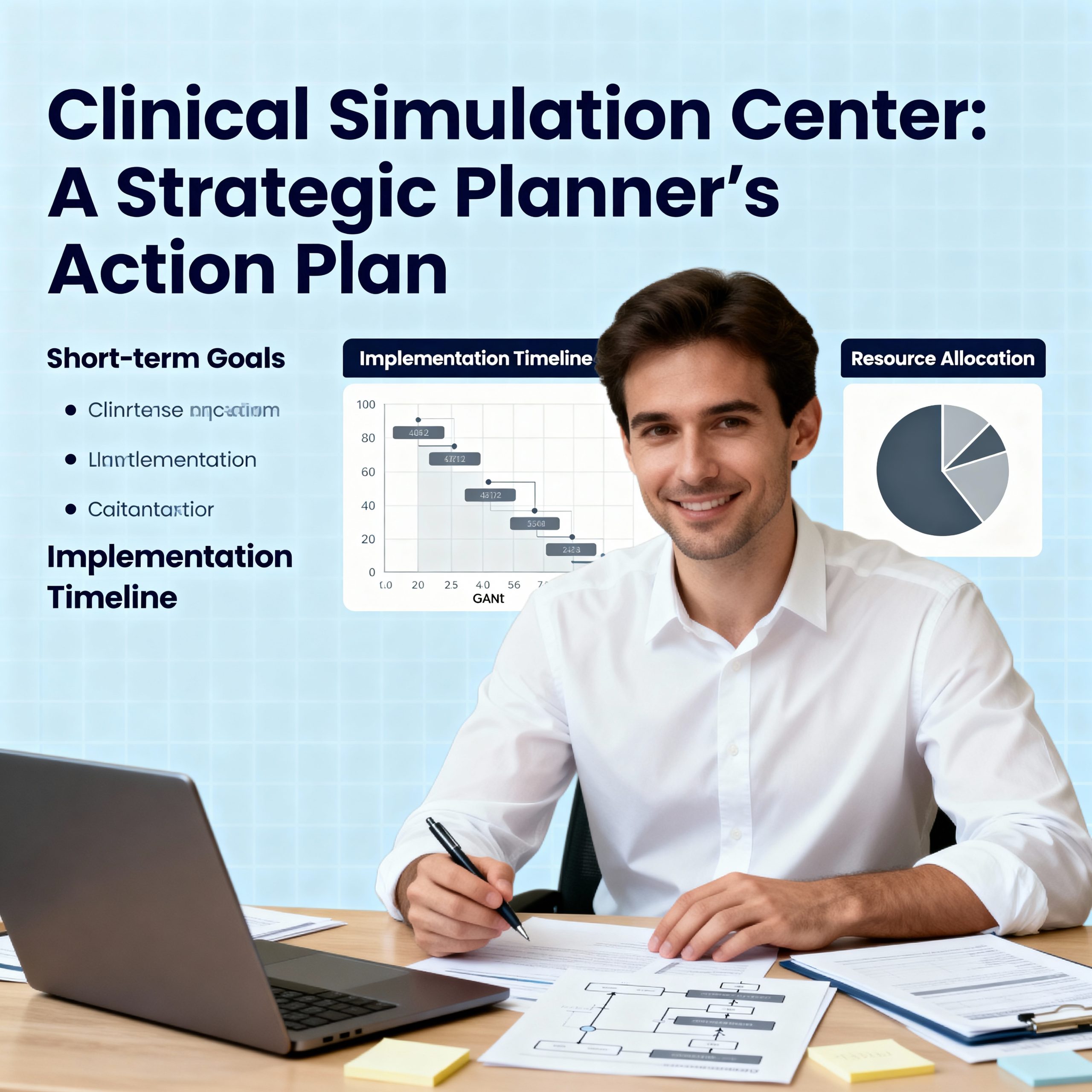
Establishing a Clinical Simulation Center: A Strategic Planner’s Action Plan

    Simulation has become a cornerstone of modern medical education, enabling learners to build clinical skills safely. In fact, experts note “overwhelming evidence demonstrating simulation’s benefit in education and patient safety, and regulatory bodies now mandate its use for high‑risk skills (e.g. India’s NMC “stress[es] using simulators where high risk is involved. Given this priority, planning a dedicated simulation center requires a clear, stepwise strategy. The following action plan, informed by published best practices and standards, outlines key steps – from initial needs assessment to implementation – specifically for clinical and postgraduate training settings. This guide is intended for institutions building a simulation facility that serves medical students, residents, and practicing clinicians, and adheres to evidence-based standards.

    Assess Institutional Needs and Define Strategy

    • Conduct a needs assessment: Begin by identifying educational and clinical training gaps. Survey programs (undergraduate, postgraduate, nursing, allied health) to determine who will use the center and for what purposes. Engaging stakeholders early is critical – form a steering committee including faculty leaders, administrators, IT/AV, and department representatives. As one guideline states, “the formation of a steering group with representatives of all stakeholders” is essential in strategic planning.

    • Align with mission and accreditation standards: Define the center’s mission, vision, and objectives to match institutional goals. Accreditation bodies like the Society for Simulation in Healthcare (SSH) and ASPiH require a formal strategic plan for any simulation program. For example, SSH guidelines emphasize having a documented mission, SMART goals, and SWOT analysis to guide resources and ROI. Use this plan to justify the center’s alignment with competency-based curricula and patient safety priorities, ensuring buy‑in from leadership.

    • Ensure organizational buy‑in: Demonstrating value is key. Prepare a business case that highlights potential benefits (improved trainee competency, reduced errors, research output) and cost‑effectiveness. Cite data or pilot outcomes where possible. This helps address a common challenge: administrators often need evidence of ROI. Also note that governance will differ by context – “governance for each centre will vary depending on funding, stakeholders, and users,” but should be backed by the strategic plan. Clarify reporting structure (e.g. under medical education, quality department, or training office) to secure funding and oversight.

    Assemble Your Team and Governance

    • Identify core personnel: Build an interdisciplinary simulation team. Key members include simulation educators, clinical faculty, curriculum designers, AV/IT specialists, and facilities managersresearchgate.net. A simulation center director or coordinator should manage day-to-day operations and align activities with the strategic plan. It is common to keep permanent staff lean (often fewer than six) and rely on subject‑matter experts for training sessions.

    • Define roles and committees: Establish clear governance. For instance, create subcommittees for curriculum integration, equipment procurement, and evaluation. Assign responsibilities (e.g. a safety officer, equipment manager, scheduling coordinator). Formal policies should cover user access, equipment maintenance, and data security. Remember that in many institutions, the center coexists with clinical workloads – coordinate with departments so clinicians can allocate time to simulation without disrupting patient care.

    • Engage simulation experts: Involve experienced simulationists (nurse educators, physicians, technologists) to train faculty and staff. Provide faculty development in scenario design, facilitation and debriefing techniques. According to standards, every simulation event requires a planned debriefing session to maximize learninginacsl.org. Plan workshops or send staff to certification courses to build internal expertise.

    Design the Space and Procure Equipment

    • Plan flexible learning environments: The physical layout should accommodate varied activities. There is no one-size-fits-all design; space depends on local needs. However, basic requirements include dedicated simulation suites, skills labs, control rooms, debrief rooms, waiting/breakout areas, and ample storage. For example, one guideline summarizes that the “basic needs are simulation rooms, skill training areas, storage areas, debriefing rooms, control rooms, waiting rooms and breakout rooms. Place the center where training can occur close to the point of care (e.g. adjacent to clinical departments). Design rooms to be reconfigurable (moveable walls, interchangeable furniture) so different scenarios (ward, ICU, OR, emergency) can be replicated. Ensure robust AV infrastructure (cameras, microphones, and network) so instructors can observe unseen and record sessions.

    • Select appropriate simulators: Inventory the “must-haves” for each program – for instance, anesthesia training requires airway and anesthesia monitors, whereas nursing may prioritize IV simulators and patient mannequins. Form a procurement committee (including educators and finance) to prioritize purchases. As recommended, steps for acquiring equipment should “include the formation of a simulation/skill committee and obtaining the educator’s request; the need should preferably come from the end user. Balance fidelity with budget – mix high-fidelity mannequins with low-cost task trainers and hybrid or VR tools to cover more scenarios. Always plan for storage of spare parts and consumables. Implement an inventory control system to track equipment location, maintenance schedules, and repairsjournals.lww.com.

    Secure Funding and Budget Wisely

    • Estimate costs and ROI: Prepare a detailed budget for construction/renovation, equipment, staffing, and recurring expenses. Perform an economic evaluation: administrators focus on capital costs, while educators value patient safety and skill gainsjournals.lww.com. Show that while simulation centers have upfront costs, they can reduce clinical errors and training accidents. Calculate metrics like cost-per-trainee or projected reductions in adverse events. As one source notes, combining cost–benefit and ROI analysis helps justify the investmentjournals.lww.com.

    • Explore diverse funding sources: In addition to institutional funds, seek grants (government or education grants) and partnerships with industry (vendors may offer educational discounts or donations). In resource-limited settings especially, collaboration can stretch budgets. For instance, it is advised that “in low-resource settings… there is a need for collaboration, context-appropriate equipment, and curricula” and that industry partnerships can mitigate budget limitsjournals.lww.com. Plan phased implementation if needed (start with a basic lab and expand later).

    • Plan for sustainability: Incorporate long-term costs into the budget (maintenance contracts, software licenses, equipment depreciation). Promote sustainable practices (reuse materials, minimize waste). One best-practice note is to “develop a sustainable procurement, maintenance, reuse and waste disposal method” for the centerjournals.lww.com. Allocating a small reserve in the budget for unexpected repairs or upgrades is prudent.

    Integrate Simulation into Curriculum

    • Embed in educational programs: Ensure simulation activities align with the curricula of all target learners. For medical and nursing students, integrate scenarios into clinical rotations and skills courses; for residents and fellows, use simulation for competency sign-offs and crisis drills. Plan specific modules for key procedures – e.g. airway management, ACLS algorithms, or interdisciplinary codes. The goal is repetitive, mastery-driven practice in a realistic settingjournals.lww.com. Simulation is not one-off; schedule regular sessions so skills and knowledge are retained.

    • Cover technical and non-technical skills: Design scenarios to teach both clinical procedures and teamwork/communication. Research shows that over 50% of medical errors are due to failures in leadership and communicationjournals.lww.com. Accordingly, include crisis resource management and interprofessional scenarios. Use standardized patients or full-team simulations for patient-centered skills (history, exam, counseling). Incorporate deliberate practice and debriefing to reinforce learning. Remember, “each simulation-based experience should include a planned debriefing process” as per INACSL standards.

    • Evaluate and adapt: Develop evaluation tools (checklists, tests, self-assessment) to measure learner performance. Track outcomes like time-to-proficiency or error rates in simulated vs. actual practice. Gather learner feedback to refine scenarios. Report results (e.g. improved exam pass rates or fewer clinical incidents) back to stakeholders; demonstrating impact is crucial for continued supportjournals.lww.com. Plan for continuous improvement by staying current with emerging standards and technologies (e.g. virtual reality, in-situ simulation).

    Implement, Operate, and Evaluate

    • Pilot and launch: Start with pilot programs to test workflows and equipment. For example, run a simulation day for a single department or skill set before full-scale opening. Use this to identify logistical issues (scheduling conflicts, technical glitches) and refine protocols. Train a cadre of “champion” faculty to conduct early sessions.

    • Operate efficiently: Establish clear processes for booking the lab, preparing scenarios, and conducting sessions. Maintain the center as you would a clinical service: clean and check equipment before each use, promptly address repairs, and restock supplies. Keep a centralized calendar to avoid overlap. Most centers function as centralized training platforms (with moderate management support)researchgate.net; decide if your center will also serve administrative roles (e.g. tracking competencies) or focus purely on education.

    • Measure impact: Collect and analyze data continuously. Metrics can include number of sessions, learner competency scores, learner satisfaction, and (where possible) downstream patient outcomes. Use this data to adjust curriculum and justify resources. As one review concludes, “putting together the right team in the right place, with suitable finances and for the right programme” is how challenges can be overcome. Iteratively update the strategic plan based on these results, in the classic cycle of assessment and reformulation.

    Emphasize Best Practices and Standards

    Throughout planning and operation, adhere to evidence-based standards. For example, INACSL’s Healthcare Simulation Standards outline best practices (prebriefing, facilitation, debriefing, operations, etc.) that should guide your center’s activities. The UK’s ASPiH publishes standards under four themes – faculty, activity, resources, and values – to ensure qualityjournals.lww.com. Use these frameworks when designing scenarios, training facilitators, and running debriefings. Finally, cultivate a culture of professionalism: maintain learner safety, respect, and ethical conduct at all times.

    Conclusion: Establishing a simulation center is a complex, resource-intensive project, but following a strategic, phased approach makes it achievable. By assessing needs, involving the right people, planning adaptable space, securing funding, and integrating simulation into curricula, institutions can build a sustainable, high-impact training facility. As guidance emphasizes, carefully addressing needs and resources up front – and adhering to simulation best practices – will ensure the center effectively enhances clinical education and patient care.

    Key Steps: Form a multi-stakeholder steering group and define mission/vision; Build an interdisciplinary team (simulation experts, IT/AV, faculty)researchgate.net; Design flexible lab space with core areas (simulation, skills, debrief, storage); Plan budget/ROI and seek diverse funding; Acquire equipment via educator‐driven procurement; Embed scenarios into curricula and include structured debriefing; Evaluate outcomes and iterate. Following these steps, aligned with published standards, will help ensure a successful simulation center launch and operation.

    Sources: Strategies and best practices are drawn from recent simulation center reviews and guidelines. These include Kumar et al. (Indian J. Anesthesia, 2024) on center development and O’Connor et al. (J. Healthcare Sim., 2018) on strategic planning, among others. Each recommendation above is supported by peer-reviewed or authoritative simulation education literature.

    Leave a Reply

    Your email address will not be published. Required fields are marked *